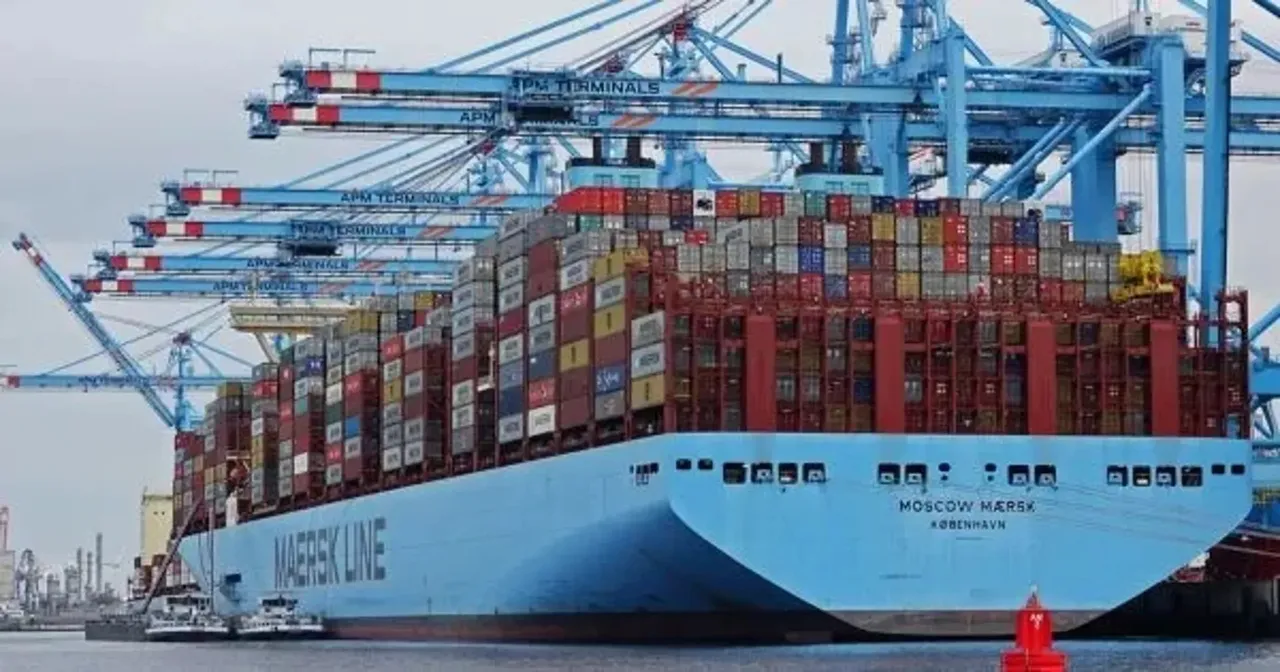
Maersk’s peak season surcharge on Far East cargo to the Gulf went live today, 16 November. It adds USD 1,000 to a 20ft container and USD 2,000 to a 40ft or 45ft box moving to the UAE, Bahrain, Kuwait, Qatar or Dammam, and the carrier has not published an end date. On a 40ft box priced against a Shanghai–Dubai rate of roughly USD 6,500, that is 31 percent on top, for a service that is slower and less predictable than it was a year ago.
The fee is real, and every importer booking this week will see it. It is also the only part of the November invoice that appears in the quote. Three charges Maersk introduced in the same fortnight sit behind the PSS, apply after the vessel berths, and together come to about the same money. Anyone building a landed cost on the PSS alone will find the margin missing in December.
This piece walks through what is in writing, what the market data says, and where the rest of the cost lands on a shipment to the UAE and its neighbours. Transit expectations for the lane have moved too; the port-by-port breakdown in our China to UAE shipping time guide sets out what each gateway currently delivers.
What the carrier put in writing
Four items matter for Gulf-bound cargo. All of them are Maersk customer advisories from late October and early November, and all were still in force in the update published on 12 November.
| Charge | Scope | Amount | Effective |
|---|---|---|---|
| Peak season surcharge (PSS) | Far East to UAE, Bahrain, Kuwait, Qatar and Dammam | USD 1,000 per 20ft; USD 2,000 per 40ft and 45ft | 16 November (19 November from Vietnam, 22 November from Korea) |
| Empty drop-off at ICD Sajaa | Empties returned at the inland dry port | USD 1,000 per 20ft; USD 1,200 per 40ft or reefer | 6 November |
| Temporary storage at Jebel Ali | Cargo discharged at Jebel Ali for transshipment | USD 25 per TEU per day, from the day of discharge | 5 November advisory |
| Paid free-time extension | Extension package at Salalah | 12 days at USD 360 per container | 5 November advisory |
Two details in that table are easy to miss. The PSS covers Dammam but not Jeddah, King Abdullah Port or Yanbu, so it prices the Gulf-side gateways and leaves the Saudi Red Sea coast outside. And the Sajaa charge is not a port tariff you can argue with at the counter. It is a condition of returning the box.
The booking restrictions from 30 October are still in place as well. Maersk is accepting cargo to Khor Fakkan, Fujairah and selected Upper Gulf destinations only against capacity it actually has, existing bookings are being renegotiated case by case, and no end date has been given. New bookings are not automatically carried over to a later sailing either.
Why a surcharge, in a market that was supposed to be falling
The logic of the last two months has been that returning capacity through Suez would pull rates down. Spot rates on Asia–Europe did soften in early November. The Gulf lane did not follow.
Container Trades Statistics put its Greater China to Middle East price index at 392 in the latest reading, up 250 percent since the start of the year and 15.5 percent month on month, while year-to-date volumes on the corridor are down 12 percent. Prices rose while volumes fell. That combination usually means the constraint is on the supply side, and in this case it is: ships waiting outside Hormuz, boxes sitting on the ground, and a relay network absorbing the delay.
The spot data agrees on direction. The Shanghai Containerized Freight Index held its Shanghai–Dubai leg around USD 6,500 per 40ft through October, about 300 percent above the USD 1,630 recorded at the end of October 2025. One market brief lists the same Persian Gulf leg at USD 6,533 per TEU, which is a different unit and a different number, so read the figure as an order of magnitude rather than a quotable rate. Linerlytica’s assessment in the same week was blunter: congestion at Middle East ports has reached a record high.
| Indicator | Latest reading | Change |
|---|---|---|
| CTS Greater China–Middle East price index | 392 | +250% since January, +15.5% month on month |
| CTS corridor volumes, year to date | — | −12% |
| SCFI Shanghai–Dubai, 40ft | about USD 6,500 | about +300% year on year |
| Maersk PSS, 40ft, as a share of that rate | USD 2,000 | about 31% |
Timing explains the rest. The Gemini FM1 service, which puts 24,000 TEU ships on a Qingdao, Ningbo, Tanjung Pelepas, Khor Fakkan and Singapore rotation, sent its first vessel out of Qingdao on 17 October. That ship, Maersk Athabasca voyage 642W, is scheduled to reach Khor Fakkan today, 16 November. Extra volume is landing at the relay port in the same week the surcharge takes effect, at a terminal Maersk describes as congested with high yard utilisation, road congestion and long truck queues. Our notes on the FM1 relaunch at Khor Fakkan cover the service itself.
The charges behind the PSS
Three charges from the same advisories work differently. None is called a freight rate, and all three are billed after the vessel berths.
The first is storage. Cargo discharged at Jebel Ali for transshipment now carries USD 25 per TEU per day, starting the day it comes off the ship. A 40ft container is two TEU, so USD 50 a day. A container waiting ten days for its onward leg has added USD 500 before anyone invoices the ocean freight. Twenty days, and it has added USD 1,000. During the September surge, boxes at the Hormuz-adjacent gateways were waiting considerably longer than that.
The second is the empty. It has to go back where the box was cleared, and that depot now has a price of its own: Maersk’s limited-acceptance tariff lists USD 1,000 for a 20ft empty and USD 1,200 for a 40ft or reefer returned at ICD Sajaa. For cargo cleared there, the empties must go back there. If the depot named on your delivery order is not taking empties when your truck arrives, the carrier issues a new instruction, and the round trip changes.
Free time has become a product. Maersk’s advisory offers free-time extensions and paid packages, for example 12 days at USD 360 per container at Salalah. A fair price on its own, and a signal of what the carrier expects: demurrage and detention priced as a routine line item rather than a penalty for negligence.
The box may also not be where the paperwork says it is. To clear space, Khor Fakkan is relocating containers to ICD Sajja, and Fujairah is moving selected full containers bound for Jebel Ali to the Al Hayl off-dock yard. Both arrangements appeared in the 26 October update and were still listed on 12 November. A transporter sent to the wrong yard burns a day and a half, and the storage clock keeps running.
What it adds up to on five containers
Take a five-container booking of 40ft high cubes from Ningbo to a consignee in Sharjah, discharged at Jebel Ali and moved overland. Base ocean freight is whatever you negotiated. The additions look like this.
| Item | Basis | Amount |
|---|---|---|
| PSS, 5 × 40ft | USD 2,000 per box | USD 10,000 |
| Transshipment storage, 14 days | USD 50 per box per day | USD 3,500 |
| Empty return at Sajaa, 5 × 40ft | USD 1,200 per box | USD 6,000 |
| Total additions | USD 19,500 |
Change the storage assumption to 20 days and the total becomes USD 21,000. Drop it to ten days and it is USD 18,500. The exact figure matters less than its shape. The charge everybody is discussing this week is about half of what the booking adds on top of freight, and the other half arrives after the ship berths.
A broker who quotes only the PSS is quoting the part of the invoice that exists before departure. Budget the rest yourself.
What the routing looks like now
The network has been rewritten around the closure, and the 12 November update spells out the current shape. Cargo for Kuwait, Iraq, Qatar, Bahrain and the UAE transships through Salalah and Khor Fakkan, moves by landbridge to Sharjah, and connects to the final destination on the intra-Gulf feeder network. It does not go through Jeddah.
Landside bookings on several corridors are paused outright: cargo from the UAE and Qatar via Jeddah and Oman, cargo from Jeddah to the UAE, Oman and Qatar, and cargo from Salalah and Sohar to the UAE, Saudi Arabia, Kuwait, Bahrain and Qatar.
Reefers are the tightest category. Bookings are suspended to and from Iraq, Kuwait, Qatar, Bahrain, Saudi Arabia (Dammam, Jubail and King Abdullah Port), Jordan and the UAE, with exceptions for Khor Fakkan and Jebel Ali via landbridge. If your product needs a reefer plug, check the acceptance list before you sell it, not after.
For Saudi consignees the calculation has shifted. Maersk reported on 9 November that use of the Saudi Landbridge rose during October as importers looked for routes into the kingdom that avoid the Hormuz side. Riyadh and Dammam cargo routed over Jeddah escapes both the Gulf relay and the PSS, which does not cover the Red Sea ports. It picks up a different set of risks, including congestion at Jeddah, which is why our Yanbu alternative analysis exists. On price alone, though, the comparison is no longer close for anything bound inland.
Kuwait, Qatar and Bahrain have no such option. Their cargo has to come through the Gulf side, which is precisely why the PSS names them.
What to do before you book
- Get the price calculation date in writing. For non-spot bookings, the rate is set by the estimated sailing date of the first ocean leg. A box that slips past 16 November can be re-rated even if you booked earlier.
- Ask where the empty returns, and whether that depot is accepting empties this week. The answer changes the cost by USD 1,000 to USD 1,200 per box.
- Count free time in days, not in weeks. Then compare that number with the actual queue at your discharge port, not with the transit time on the quote.
- Check the destination against the current restriction list before you accept a booking. A destination that is open today can be restricted by the next weekly update.
- Price two gateways, not one. Jebel Ali against Khor Fakkan, or Jeddah landbridge against Dammam, with the inland leg shown separately.
- Ask for the itemised version: ocean freight, PSS, war risk, any redirection or emergency charge, destination charges, storage exposure and empty return. Our surcharge explainer lists the line items that legitimately appear on a China–GCC invoice.
None of these habits changes the conditions on the water. The PSS will probably be extended past the next review date, and the storage and empty-return rules will stay in force for as long as boxes are queueing at the relay ports. What you can control is whether those costs land in your quote or in your margin.
Our booking plan for the GCC peak season sets out the lead times that are actually working at the moment, and the China to Kuwait route page covers the Upper Gulf corridors that this surcharge hits hardest. If you are shipping to the UAE itself, the numbers for Jebel Ali and Khor Fakkan are on the shipping from China to UAE page.
- WhatsApp: Get a quote now