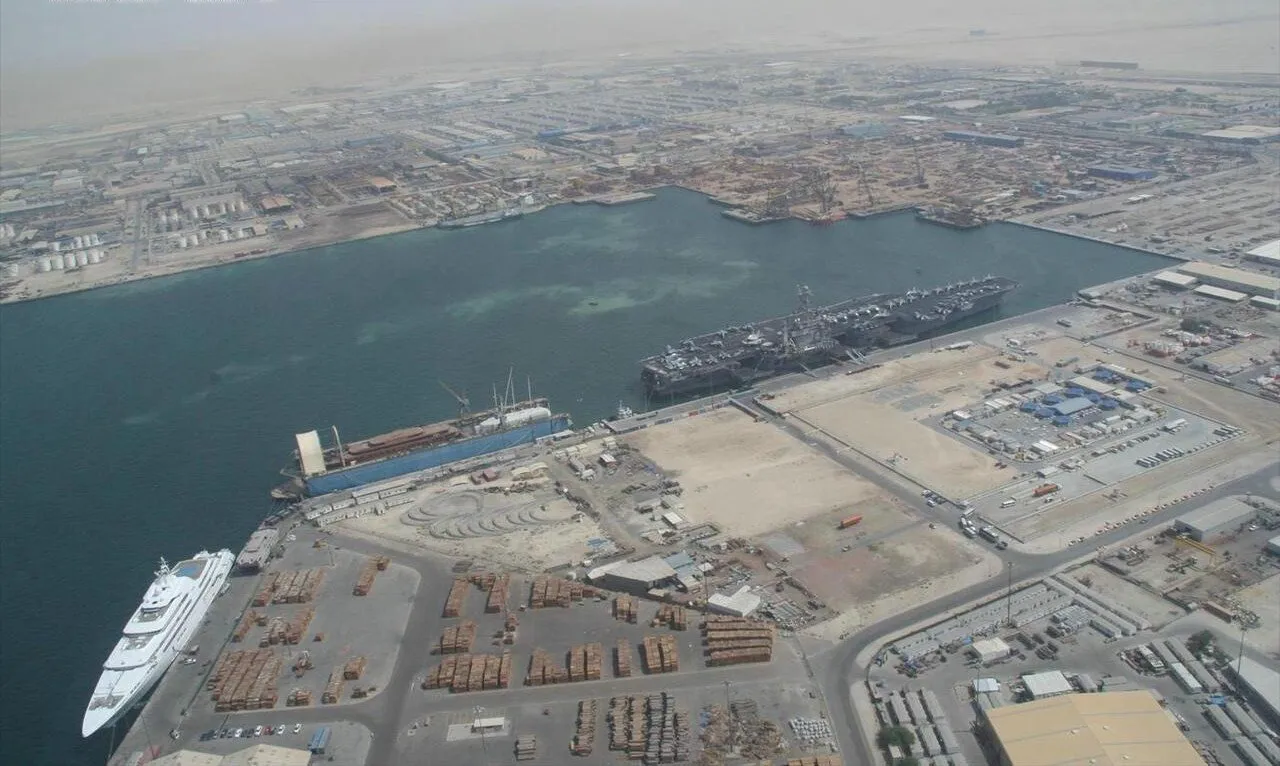
Ask a forwarder how long shipping from China to the UAE takes and you will get a number between 14 and 25 days. Ask two forwarders and you will get two numbers. Both may be honest and both may be wrong, because in 2026 the answer stopped being a property of the route and became a property of the gateway you land in.
The old figure — roughly 14 to 20 days from Shenzhen to Jebel Ali, 18 to 24 from Shanghai or Ningbo — described a world where a direct Asia–Gulf call discharged your container at the largest port in the Middle East and a truck took it to Dubai the next morning. That world has been under stress since the Strait of Hormuz effectively closed to commercial traffic at the end of February 2026. Jebel Ali handled 374,000 TEU in the second quarter of this year, down 90.1% year on year; the port that moved 15.55 million TEU in 2025 now appears in Maersk’s booking terms as “Jebel Ali (via landbridge)”.
So this is a transit-time guide for the current network, not the brochure one. It breaks the journey into the five clocks that actually decide your delivery date, gives port-by-port ranges for shipping from China to UAE, and shows where a week disappears before anyone tells you.
Why the schedule broke
The mechanism matters because it explains why your container can wait in a port that reports almost no vessel queue.
Since US and Israeli strikes on Iran on 28 February 2026, the Strait of Hormuz has been, in the words of industry analysts, effectively closed — not by a declared decree but by war-risk pricing. Additional premiums that cost about 0.25% of hull value before the strikes peaked near 10%, and Marsh put them at 3%–8% in late June, equivalent to USD 3–8 million for a single large tanker transit. Capital does not sail into that.
The consequences for container traffic, measured through IMF PortWatch data by Container Management:
| Indicator | Before the crisis | Late 2026 |
|---|---|---|
| Containership transits through Hormuz | 16.5 per day (2025 average) | 0.5 per day (30 days to 9 August) |
| Containership capacity crossing Hormuz | About 420,000 dwt per day | About 7,700 dwt per day |
| Jebel Ali quarterly throughput | 3.7 million TEU in Q2 2025 | 374,000 TEU in Q2 2026 |
| Jebel Ali weekly average | About 299,000 TEU | About 28,800 TEU |
| Khor Fakkan weekly throughput | About 8,000 TEU | About 65,000 TEU by early July |
| AD Ports UAE container volumes | Q2 2025 baseline | Down 65% in Q2 2026 |
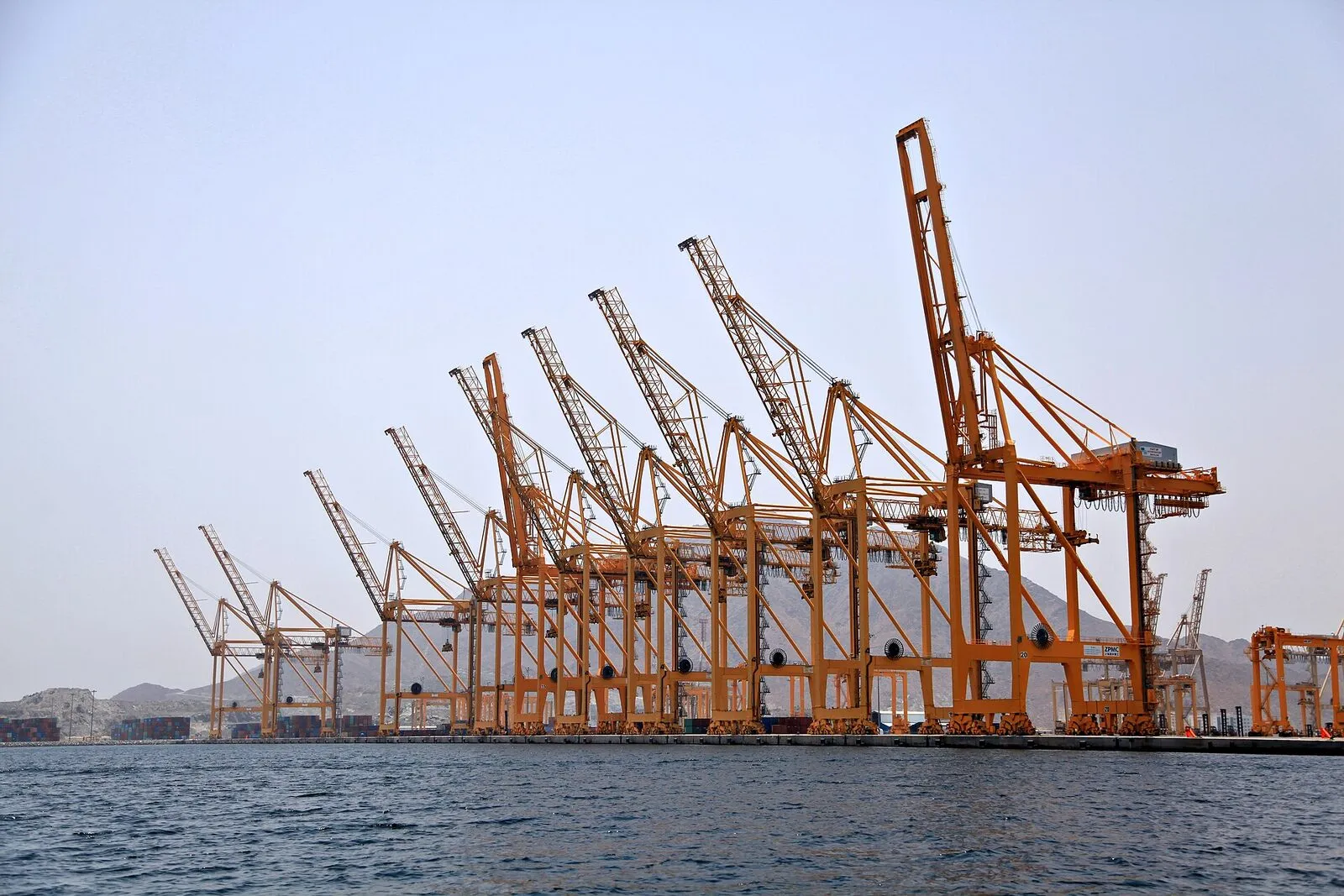
Carriers did not abandon the UAE. They moved the UAE’s sea gate to the other coast. Khor Fakkan sits on the Gulf of Oman, outside the strait, and its weekly throughput multiplied roughly eightfold in five months. Gulftainer, which runs the terminal, launched a USD 2 billion expansion to lift capacity from 3.5 million to 10 million TEU over 36 months and says it could absorb 90% of national container demand if the strait stays shut.
That is the network your box now uses. It works, but it is a lifeboat carrying lifeboat traffic.
What transit looks like now, gateway by gateway
The table below is door-to-door to a Dubai warehouse, not port-to-port. Port-to-port figures are the ones that make quotes look good.
| Gateway | Ocean leg from South China | Queue and port time | On-carriage | Realistic door-to-door |
|---|---|---|---|---|
| Direct Jebel Ali call (when one is scheduled) | 18–22 days | 0.25–3 days | Same day to next day | 22–30 days |
| Khor Fakkan, then road | 18–22 days | 7.25 days average vessel wait, plus 12–15 days inter-terminal transfer | Included in the transfer | 38–50 days |
| Sohar, then road to Dubai | 20–24 days | 2–3 days | 3–5 days | 27–34 days |
| Salalah, then feeder or road | 22–26 days | 2–5 days | 5–10 days | 30–42 days |
| Air to DXB or DWC | 1–2 days flying | 1–2 days | Same day | 4–7 days |
Read the first row carefully. Jebel Ali has not stopped accepting boxes; it has stopped receiving a predictable volume of them. Hapag-Lloyd’s Middle East update in early October listed Jebel Ali as “ad-hoc vessels only”, and Maersk’s 12 August operational update began booking Jebel Ali as a road destination via landbridge. A direct call is the fastest routing available — when your carrier has one. That “when” is the whole problem with planning around it.
The five clocks inside “shipping time”
A single quoted transit figure hides five separate waits. When a shipment slips by two weeks, one of these moved, and you can usually tell which.
- Sailing time. The ocean leg itself. This has barely changed: South China to the Gulf of Oman or the Gulf is still 18–22 days at service speed.
- Anchorage. The wait before berthing. At Jebel Ali this is now trivial — Portcast measured a median vessel wait of 0.25 days for 18–24 October. At Khor Fakkan it is 7.25 days as of 30 October, per Kuehne+Nagel.
- Berth and yard. Discharge, and the time the box sits before release. Jebel Ali’s export dwell has averaged 26.8 days during the conflict against 8.5 days before it, according to project44 — a measure of how long equipment and boxes cycle, and a warning about yard fluidity even where vessel queues are short.
- Inter-terminal transfer. If your box lands on the east coast and your consignee is in Dubai, this is the leg that ate the calendar in October. Transfer times from Khor Fakkan and Fujairah to Jebel Ali, Sharjah and Abu Dhabi rose from roughly five days to 12–15 days, Kuehne+Nagel reported on 30 October.
- Customs and delivery. UAE clearance is normally one to three working days with documents in order, plus Dubai Customs or free-zone formalities. This clock is stable, and it is the one most often blamed for someone else’s delay.
Khor Fakkan: the lifeboat is now the traffic jam
Khor Fakkan’s numbers are extraordinary and its service levels are not. The port took the traffic that could no longer reach Jebel Ali, and by late October it was reporting:
- average vessel waiting time of 7.25 days
- ships arriving an average of 7.4 days behind schedule over the previous 30 days, and departing 5.7 days late
- restrictions on discharging foreign cargo, dangerous goods and special equipment
- some carriers cutting allocation quotas for Khor Fakkan and Sharjah
Add the 12–15 day transfer to Dubai and you have a routing that can consume six weeks from factory gate to warehouse, against a pre-crisis 22–25 days. Kuehne+Nagel told customers on 30 October to expect conditions to deteriorate further into November, driven by high import volumes, precautionary stockpiling and yard congestion.
None of this makes Khor Fakkan the wrong choice. It is often the only choice that keeps cargo moving at all. It does mean the port you name in the booking decides your delivery date, and that the difference between gateways is now measured in weeks.
Jebel Ali: low waiting time, low volume, slow release
The apparent contradiction of a port with a 0.25-day anchorage wait and a 90% volume collapse resolves once you separate vessel congestion from cargo fluidity. Vessels berth quickly because few arrive. Containers still move slowly because the surrounding network — empties, landbridge legs, transhipment feeds from Colombo, Salalah and Singapore — is out of balance.
Project44’s 29 October update makes the point across the region: weekly diversions from Middle East ports are running at about 2.4 times the pre-conflict level, and transhipment dwell is up to 59% above baseline at key ports in Sri Lanka and India. A box that needs to tranship twice before it reaches the UAE is exposed to both dwell increases.
For a shipper, the practical translation is this: Jebel Ali is fast at the berth and unpredictable at the booking desk. If your carrier has a call, take it. If your quote depends on one being added, treat the ETA as a hope rather than a date.
Air freight, and when it wins
Air freight from China to the UAE has kept its shape: one to two days flying from Guangzhou, Shenzhen, Shanghai or Hong Kong to Dubai, plus a day of clearance and delivery, so four to seven days door-to-door. Freightos quotes roughly 31–41 days for sea from Shanghai to Dubai and 6–10 days for air on the same lane, which is the practical spread you are choosing between.
Air does not compete on cost — at typical 2026 levels it is several multiples of an ocean rate per kilo — but the calculus changes once the ocean option is a 40-day routing with a quota restriction at the discharge port. For high-value electronics, fashion with a season attached, or a line-down spare part, the air premium is now often smaller than the cost of a month of stuck inventory.
Transit by Chinese origin port
Gateways shift the total, but origin still moves it by several days. Indicative ocean sailing times to the UAE gateways above:
| Origin | Best-case sailing | Add for congestion | Notes |
|---|---|---|---|
| Shenzhen (Yantian, Shekou) | 14–18 days | +0–7 days | Most frequent UAE connections |
| Guangzhou (Nansha) | 16–20 days | +0–7 days | Close to Shenzhen schedules |
| Ningbo | 18–24 days | +2–8 days | Strong for consolidated LCL |
| Shanghai | 18–24 days | +2–8 days | Deepest carrier choice |
| Qingdao | 22–28 days | +2–8 days | Northern China production base |
| Tianjin/Xingang | 24–32 days | +3–10 days | Fewest direct options |
Those are sailing times. Add the queue and transfer columns from the gateway table to reach a delivery date. Any quote that gives you a single number without saying which port and which on-carriage leg it assumes is not a transit time; it is a hope with a decimal point.
What to ask before you book
- Which gateway, exactly? Jebel Ali direct, Khor Fakkan, Sohar or Salalah. Insist on the port name in writing, not “UAE”.
- What is the on-carriage leg, and who owns the risk on it? A 12–15 day transfer is a contracted service with its own liability terms.
- Does the carrier have quota restrictions at the discharge port? Allocation cuts are the quietest cause of a missed week.
- What is the current vessel waiting time at that port? Ask for the figure and its date; a number without a date is decoration.
- Is clearance included, and in which emirate? Dubai, Sharjah and Abu Dhabi clearances are not interchangeable.
- What is the free time, and what does detention cost after it? With transfers running 12–15 days, free time on the inland leg decides whether a delay becomes a cost.
Planning rule for the rest of 2026
Build your dates backwards from the gateway, not forward from the factory. If you need cargo in Dubai before a fixed date, the sequence is: choose the gateway, add its current queue, add the transfer, add clearance, and only then compare with your production lead time. If the answer does not fit, the decision is air freight or an earlier booking — not a more optimistic assumption.
Two structural points are worth holding in mind. First, capacity is being added where the traffic went: Gulftainer’s USD 2 billion Khor Fakkan programme and the carrier landbridge products now bookable to Jebel Ali are both permanent investments, and the network that emerges will not snap back to the pre-February shape. Second, the risk runs in one direction for now — Kuehne+Nagel expects further deterioration in the coming weeks, driven by peak import volumes and stockpiling.
For importers, that argues for two habits: book earlier than the transit time suggests, and keep a second gateway quoted and ready before you need it.
If you want a delivery date rather than a range, send us the origin city, the destination emirate and the cargo profile. We will price each viable gateway with the sailing, the queue and the on-carriage shown separately, so you can see exactly where the weeks go.
- WhatsApp: Get a quote now
- Or check our container shipping guide from China to UAE for rates and documentation.