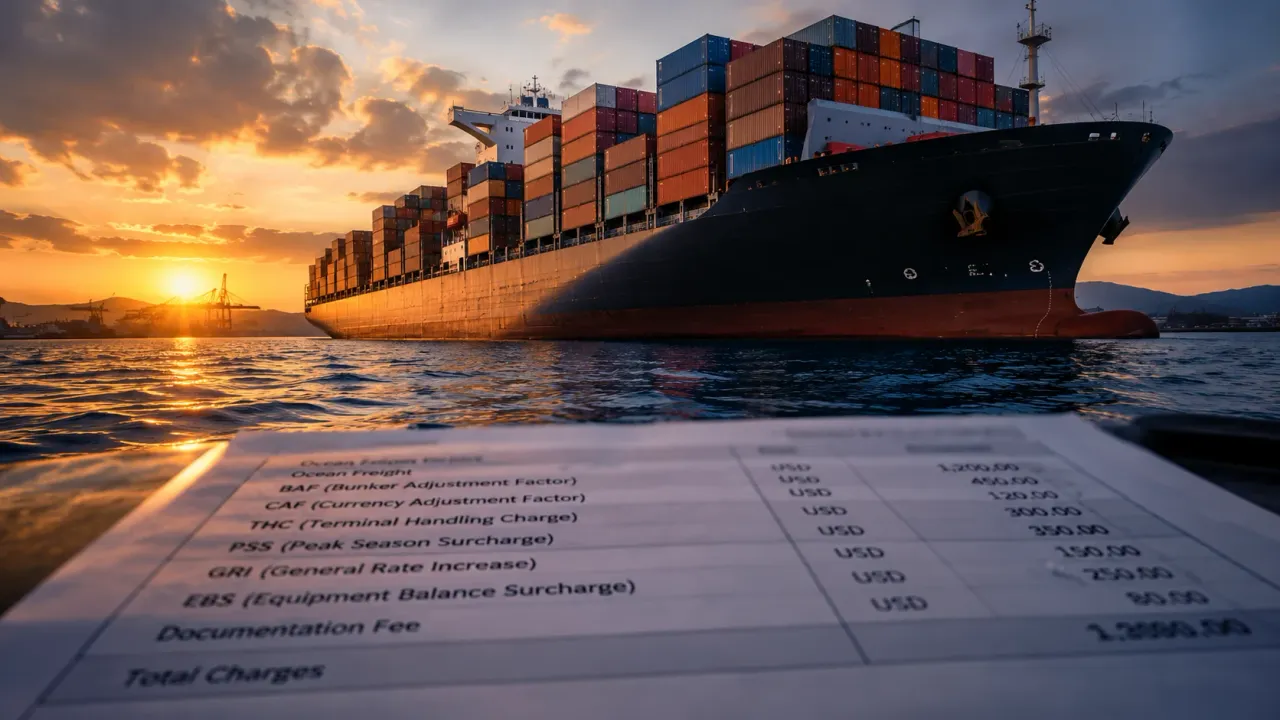
Ask any importer on shipping routes from China to the GCC what surprised them most this year, and the answer is rarely the base ocean rate. It is the list of surcharges underneath it. A quote that starts at a competitive freight rate can arrive with several additional line items — PSS, WRS, ECS, RCR, deviation fees — and together they can add hundreds, sometimes thousands, of USD per container.
This guide explains every major surcharge you are likely to see on a China–Middle East quote in late 2026, the actual rate levels the major carriers are charging, and the practical steps to control them.
Why Surcharges Now Dominate China–GCC Quotes
On a normal trade lane, base ocean freight makes up 70–80% of what you pay the carrier. On China–Gulf lanes since early 2026, that share has dropped sharply. The combination of Hormuz transit restrictions, Red Sea disruption and carrier security protocols has pushed carriers to recover costs through explicit, itemized surcharges rather than the base rate alone. Our analysis of the Middle East freight rate surge shows that a single container to Saudi Arabia or the UAE can now carry three to five separate surcharge layers at once.
Understanding each layer is the first step to negotiating them.
PSS: Peak Season Surcharge
What it is: a seasonal fee carriers apply when demand exceeds available vessel space. Despite the name, PSS on Far East–Middle East trades has been applied almost continuously through 2026, because Gulf capacity has been structurally tight rather than seasonally busy.
Actual 2026 levels (Maersk, Far East → Middle East):
| Origin | Destination | PSS per container | Effective |
|---|---|---|---|
| China main ports (Dalian, Qingdao, Xingang, etc.) | UAE, Saudi Arabia, Kuwait, Qatar, Oman, Bahrain, Jordan, Iraq | USD 800 | 01-Jan-2026 |
| Japan, South Korea | Same GCC destinations | USD 400 | 01-Jan-2026 |
| Other Southeast Asia origins | Same GCC destinations | USD 1,000 | 01-Jan-2026 |
| China / Hong Kong / ASEAN | GCC + Salalah, Sohar, Khor Fakkan, Jeddah | USD 700, later USD 500 | 15-Mar-2026 / 30-Mar-2026 |
How it is calculated: PSS is charged per container, not by weight or value, and applies to both 20ft and 40ft boxes at the same rate. Maersk applies it based on the Price Calculation Date (PCD) — the scheduled departure of the first vessel leg at booking confirmation — and it does not apply to SPOT bookings, which already embed the premium in the all-in rate.
How to control it: book before the announced effective date, consider SPOT rates when PSS spikes, and consolidate cargo into fewer, fuller containers, since PSS is per-box.
WRS: War Risk Surcharge
What it is: the fee carriers charge to cover sharply higher war-risk insurance premiums on vessels entering designated high-risk waters. In 2026 that means the Strait of Hormuz and, for many sailings, the Red Sea approaches.
Actual 2026 levels:
| Carrier | Surcharge | Level | Scope |
|---|---|---|---|
| Hapag-Lloyd | WRS | USD 1,500 per TEU dry; USD 3,500 per reefer/special | Cargo to/from/via the Upper Gulf: UAE, Saudi Arabia (Dammam, Jubail), Kuwait, Qatar, Bahrain, Oman, Iraq, Yemen — effective 02-Mar-2026 |
| MSC | WRS | From USD 1,200 per TEU; about USD 3,000 per 40ft | Gulf-adjacent routes, bookings from early March 2026 |
| CMA CGM | Emergency Conflict Surcharge | USD 2,000 per 20ft dry; USD 3,000 per 40ft dry; USD 4,000 per reefer | Gulf trades, with limited access maintained via multimodal routing through Sohar |
The reason the numbers are so large: war-risk premiums for Gulf waters have reached 3%–6% of hull value, versus 0.3%–1% for Red Sea routings. Carriers pass this directly to cargo owners. Reefer and special equipment pay the highest WRS because the exposure and handling complexity are greater.
Important nuance: WRS is normally quoted as “payable by the sea freight payer.” In a DDP arrangement where your forwarder pays the ocean leg, WRS is inside your all-in quote — which is exactly why comparing DDP quotes line-by-line matters more than ever. See our guide to DDP shipping to the Middle East for how detention and inspection fees interact with these surcharges.
ECS and EFS: Emergency Conflict and Fuel Surcharges
Alongside WRS, carriers introduced “emergency” recovery fees in 2026:
- ECS (Emergency Conflict Surcharge): typically USD 200–500 per container, covering security compliance, crew risk allowances and operational disruption on Gulf routings. CMA CGM’s version, listed above, is the heaviest in the market.
- EFS (Emergency Fuel Surcharge): introduced by several carriers from April 2026 to recover bunker costs from longer routings and slow steaming around risk areas.
Both are usually charged per container and apply on top of WRS, not instead of it.
Redirection, Deviation and RCR Fees
These are the surcharges importers least expect, because they often appear after booking:
- Deviation / redirection surcharge: when a vessel skips a scheduled Gulf call or a booking is rerouted, carriers charge for the extra handling. MSC applied a deviation surcharge of around USD 800 per container during the March 2026 disruption window.
- Short-shipment and re-routing costs: if your cargo is discharged at a transshipment hub such as Jebel Ali or Sohar instead of the final port, you may pay additional on-carriage plus a redirection fee.
- RCR (Regional Cost Recovery): the newest label. MSC announced an RCR surcharge on Europe–Middle East bookings effective 01 October 2026 in response to sustained demand growth. Expect similar recovery-style fees to spread to Asia–Gulf trades whenever capacity tightens again.
The common thread: carriers are increasingly separating “the cost of moving the box” from “the cost of operating in a disrupted region.” Importers who only negotiate the base rate are negotiating the smaller number.
The Other Line Items You Should Recognize
Beyond the 2026-specific fees, standard surcharges still appear on most quotes:
| Surcharge | What it covers | Typical behavior |
|---|---|---|
| BAF / FAF | Bunker (fuel) price adjustment | Fluctuates monthly with fuel markets |
| THC | Terminal handling at origin and destination port | Charged per container, port-specific |
| EIS | Equipment imbalance (empty container repositioning) | Appears when a port lacks empty boxes |
| Congestion surcharge | Port delays and berth waiting time | Spikes during peak periods or disruptions |
| Seal / documentation fees | Container sealing and paperwork | Small but fixed; check for duplicates |
| Low-sulfur surcharge (LSF) | Compliance with IMO emission rules | Usually folded into BAF on modern quotes |
None of these are inherently illegitimate — but they are negotiable in aggregate, and they are frequently double-counted on quotes from less careful intermediaries.
How to Read a China–GCC Quote Like a Professional
When a quote arrives, run this five-point check before comparing it with another:
- Separate the base rate from the surcharges. Two quotes with the same headline rate can differ by USD 1,500 per container in surcharges.
- Check which surcharges are per-TEU and which are per-container. WRS quoted per TEU means a 40ft box pays double the headline number.
- Confirm the PCD or booking-date rules. A surcharge announced “effective next month” may apply to your shipment depending on when you book, not when the vessel sails.
- Ask what happens if the routing changes. Is the deviation fee capped? Who pays if the vessel drops a port call?
- For DDP quotes, demand one all-in number. Your forwarder should absorb surcharge volatility inside a fixed DDP price — that is what you are paying them to manage.
What This Means for Your Q4 2026 Budget
Heading into the October–December peak, budget planning on China–Gulf lanes should assume:
- PSS returning or staying elevated on China-origin bookings (Q4 announcements typically land in early October).
- WRS remaining in place on all Upper Gulf routings while Hormuz restrictions persist.
- At least one additional recovery-style fee (RCR or equivalent) on congested trades.
- An all-in surcharge stack of roughly USD 1,000–3,000 per 40ft container on top of base freight, depending on carrier, routing and port of discharge.
For a realistic baseline of total landed cost by market, cross-reference our shipping cost guide for the UAE and the current Suez Canal surcharge picture.
How GCC Freight Handles Surcharges for You
Since 2016 we have moved cargo from China to Saudi Arabia, the UAE, Kuwait, Qatar, Oman, Bahrain and Jordan through every kind of rate environment. Our approach in 2026 is simple:
- Fixed all-in DDP quotes where PSS, WRS, ECS and deviation risk are absorbed into one agreed price — no surprise line items after booking.
- Route optimization across Red Sea and Gulf entry points to avoid the heaviest surcharge combinations where your delivery schedule allows.
- Surcharge auditing: we review every carrier invoice against the booking conditions and challenge incorrect or duplicated fees on your behalf.
If your current quotes are stacking surcharges you do not fully understand, send them to us. We will break them down line by line and tell you exactly what is legitimate, what is negotiable, and what a realistic all-in number looks like for your lane.
- WhatsApp: Get a transparent all-in quote now