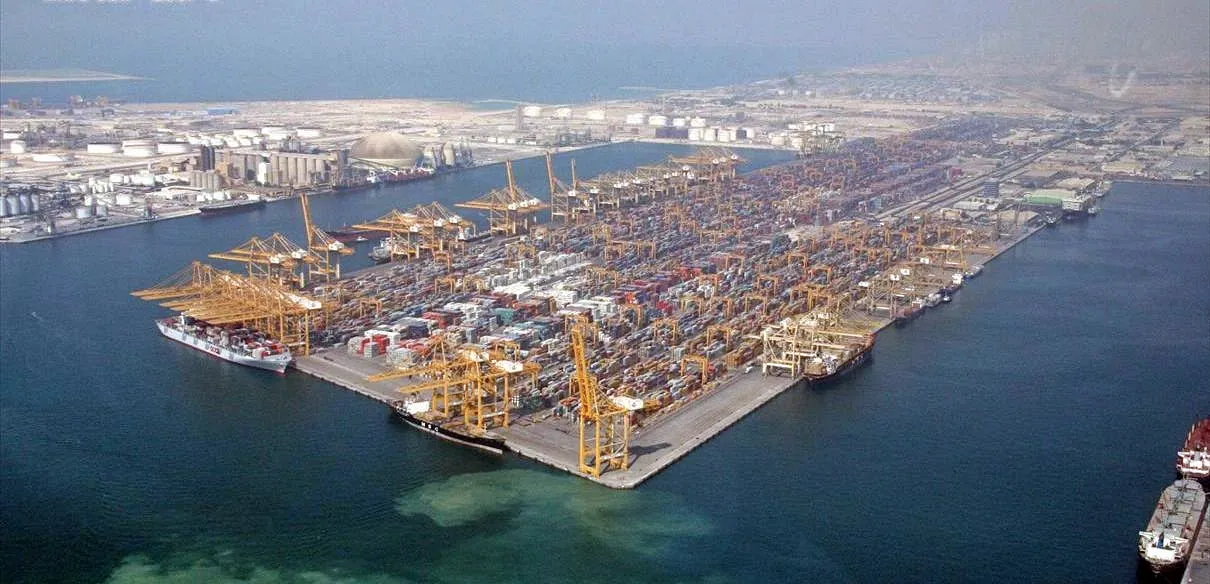
If you import goods from China to Saudi Arabia, Qatar, Kuwait, or any other GCC country, routing your cargo through Jebel Ali Port in Dubai could be faster, cheaper, and more flexible than you expect. In 2026, Jebel Ali continues to strengthen its position as the largest and most important logistics hub in the Middle East, having set new records in container throughput.
In this guide, we explore the latest developments at Jebel Ali, why many importers and regional distributors prefer using Dubai as a transshipment point rather than shipping directly to each country, the available shipping lines, and how GCC Freight helps you maximize this competitive advantage.
Jebel Ali 2026: Record-Breaking Numbers
Key Statistics
Jebel Ali Port — operated by DP World — achieved a new record in 2025, surpassing 19.5 million TEU (twenty-foot equivalent units) annually. This makes Jebel Ali:
- The largest port in the Middle East and North Africa.
- Among the top 10 container ports globally.
- Connected to over 150 international shipping lines serving more than 100 ports worldwide.
- Offering 80+ weekly sailings connecting China to Dubai directly.
What this means for importers: Higher shipping line density means more departure options, shorter waiting times, and better pricing leverage.
Recent Expansion Projects
During 2025–2026, several expansion projects were completed:
- New berths added to accommodate Ultra Large Container Vessels.
- Digital infrastructure upgrades to accelerate customs clearance processes.
- JAFZA expansion to accommodate more logistics centers and warehouses.
Why Transshipment Through Dubai Beats Direct Shipping
1. Cost Savings
When you ship goods from China to Dubai first, then redirect them to Saudi Arabia, Qatar, or Kuwait, you benefit from:
- Economies of scale: Shipping to a mega-port like Jebel Ali means competitive rates due to intense competition among carriers.
- Cargo consolidation: You can combine goods from multiple suppliers in China into one container to Dubai, then distribute across GCC countries based on demand.
- Avoiding multiple small shipments: Instead of sending 3 separate LCL shipments to Saudi Arabia, Qatar, and Kuwait, you can send one container to Dubai and distribute locally.
2. Speed and Flexibility
- Frequent sailings: With 80+ weekly sailings from China, you can choose the nearest departure date.
- Temporary storage: If a particular market is slow, you can store goods in Dubai until demand improves.
- Destination flexibility: You can change the final destination based on actual demand rather than committing to a single destination from China.
3. JAFZA: The World’s Largest Free Zone
Jebel Ali Free Zone (JAFZA) sits directly adjacent to the port and is the world’s largest free zone. Benefits for importers include:
- Full customs duty exemption while goods remain inside the zone.
- VAT exemption.
- 100% foreign ownership permitted.
- Unlimited storage duration.
- Re-export to GCC countries without additional duties.
Practical example: You import goods worth AED 100,000 into JAFZA. You pay zero customs duty and zero VAT. You sell 40% to the UAE market (paying duty and VAT only on that portion), and re-export 60% to Saudi Arabia without any additional charges.
Shipping Line Options from China to Jebel Ali
Direct Services (Recommended)
| Carrier | Route | Transit Time | Frequency | Key Strengths |
|---|---|---|---|---|
| COSCO | Shanghai/Shenzhen → Jebel Ali | 14–18 days | Daily | Competitive pricing, wide coverage |
| MSC | Ningbo/Xiamen → Jebel Ali | 15–19 days | Daily | Massive network, large capacity |
| Maersk | Shanghai/Qingdao → Jebel Ali | 16–20 days | Daily | High reliability, advanced digital tracking |
| CMA CGM | Shenzhen/Guangzhou → Jebel Ali | 14–18 days | Daily | Excellent service, multiple routes |
| Hapag-Lloyd | Shanghai/Shenzhen → Jebel Ali | 15–19 days | Daily | Premium quality, schedule integrity |
| ONE | Shanghai/Ningbo → Jebel Ali | 15–19 days | Daily | Modern fleet, fuel efficiency |
Transshipment Services (Additional Options)
| Carrier | Route | Transit Time | Notes |
|---|---|---|---|
| PIL | Singapore/Colombo → Jebel Ali | 18–24 days | Lower rates, slower transit |
| RCL | Port Klang/Colombo → Jebel Ali | 20–26 days | Suitable for non-urgent cargo |
Tip: For urgent shipments, choose direct services. For cost-sensitive, non-urgent cargo, consider transshipment options.
Dubai to GCC Cross-Border Options
1. Road Freight (Most Common)
| Destination | Distance | Transit Time | Estimated Cost (per CBM) |
|---|---|---|---|
| Riyadh (Saudi Arabia) | ~970 km | 2–3 days | $15–$25 |
| Jeddah (Saudi Arabia) | ~1,950 km | 3–4 days | $20–$35 |
| Dammam (Saudi Arabia) | ~850 km | 2–3 days | $15–$25 |
| Doha (Qatar) | ~690 km | 1–2 days | $12–$20 |
| Kuwait | ~1,300 km | 2–3 days | $18–$30 |
| Muscat (Oman) | ~450 km | 1–2 days | $10–$18 |
| Manama (Bahrain) | ~500 km | 1–2 days | $10–$18 |
2. Sea Freight (For Large Volumes)
| Destination | Transit Time | Estimated Cost (per TEU) |
|---|---|---|
| Jeddah | 3–5 days | $400–$700 |
| Dammam | 2–4 days | $300–$600 |
| Doha | 1–2 days | $200–$400 |
| Kuwait | 2–3 days | $250–$500 |
| Muscat | 1–2 days | $150–$300 |
3. Air Freight (For Urgent/High-Value Cargo)
| Destination | Transit Time | Estimated Cost (per kg) |
|---|---|---|
| Riyadh/Jeddah/Dammam | 2–4 hours | $3–$6 |
| Doha | 1–2 hours | $2.5–$5 |
| Kuwait | 1.5–2.5 hours | $3–$5.5 |
| Muscat | 1 hour | $2–$4 |
Note: Air freight from Dubai to GCC countries is typically used for urgent or high-value goods, while road freight is preferred for general cargo due to lower cost and reasonable speed.
Transshipment Benefits by Country
For Saudi Arabian Importers
- Avoid Saudi port congestion: Jeddah and Dammam ports are busy, and clearance takes longer.
- Temporary storage: Store goods in Dubai while awaiting SABER approval or import licenses.
- Consolidation: Collect goods from multiple Chinese suppliers, then distribute to your warehouses in Riyadh, Jeddah, and Dammam.
For Qatari Importers
- Avoid geographic restrictions: Direct shipping to Qatar sometimes requires specific routes.
- Strategic storage: Dubai as a central storage hub for the region.
- Distribution flexibility: Send goods to Qatar based on actual demand.
For Kuwaiti Importers
- More shipping lines: China to Dubai offers far more options than China to Kuwait direct.
- Lower costs: Shipping to Dubai then Kuwait is often cheaper than direct shipping.
- Consolidation and preparation: Combine multiple shipments in Dubai before sending to Kuwait.
For Regional Distributors (Multi-Country Coverage)
If you are a distributor covering Saudi Arabia, UAE, Qatar, and Kuwait, using Dubai as a logistics hub gives you:
- One central inventory: Instead of stocking in 4 countries, store in Dubai and redirect based on demand.
- Reduced dead stock: Send goods to each country based on actual demand rather than forecasting.
- Currency risk reduction: Pay in UAE Dirhams (AED) for the main shipment, then sell in Saudi Riyals (SAR) or Qatari Riyals (QAR) depending on the market.
How GCC Freight Supports Your Jebel Ali Transshipment Strategy
At GCC Freight, we specialize in China-to-GCC shipping via Dubai. We offer an integrated solution:
1. Our Jebel Ali Warehouse
- Strategic location: Our warehouse sits near Jebel Ali Port and JAFZA.
- Short-term and long-term storage: Store goods for days or months as needed.
- Order fulfillment: Sorting, repackaging, and preparing goods for final shipment.
- Digital tracking: Warehouse Management System (WMS) lets you check inventory in real time.
2. Cross-Docking Services
- Cargo receipt: We collect your container directly from the port.
- Sorting and consolidation: We sort goods by final destination (Saudi Arabia, Qatar, Kuwait, etc.).
- Final delivery: We send each portion via the best mode (road/sea/air) based on priority and cost.
3. Customs Clearance at Jebel Ali
- Dedicated team: We deal with UAE customs daily.
- Green channel target: We aim for green channel clearance (1–3 hours) for every shipment.
- JAFZA handling: If you use the free zone, we manage entry and exit procedures.
4. Road Freight to GCC Countries
- Reefer and dry trucks: For all cargo types.
- Full coverage: Saudi Arabia (Riyadh, Jeddah, Dammam), Qatar (Doha), Kuwait, Oman (Muscat), Bahrain (Manama).
- GPS tracking: Know your shipment’s location at all times.
- Door-to-door delivery: From our Dubai warehouse to your final destination warehouse.
5. Full Logistics Support
- Consolidation: Combine goods from multiple Chinese suppliers into one container.
- Deconsolidation: Split goods in Dubai and distribute to destinations.
- Repackaging: Package goods to suit the target market.
- Labeling: Add Arabic labels according to each country’s requirements.
6. Free Consultation
- Cost analysis: We analyze whether Dubai transshipment is cheaper than direct shipping for your case.
- Carrier selection: We guide you to the best lines based on timing and cost.
- Inventory planning: We help you determine optimal stock levels in Dubai.
Direct Shipping vs. Dubai Transshipment: A Comparison
| Criteria | Direct Shipping (China → Saudi Arabia) | Transshipment via Dubai |
|---|---|---|
| Shipping lines | Limited (10–15 carriers) | Extensive (80+ weekly sailings) |
| Transit time | 18–25 days | 14–18 days (China→Dubai) + 2–3 days (Dubai→Saudi Arabia) |
| Ocean freight cost | 10–20% higher | Lower due to competition |
| Temporary storage | Not available | Available in JAFZA |
| Multi-supplier consolidation | Difficult | Easy |
| Destination change | Impossible after shipping | Possible in Dubai |
| Customs clearance | Slower at Saudi ports | Faster at Jebel Ali |
| Flexibility | Low | Very high |
Bottom line: For importers who need flexibility, storage, and cargo consolidation, Dubai transshipment is the optimal choice. For straightforward, single-country shipments, direct shipping may be suitable.
Frequently Asked Questions About Jebel Ali Transshipment
Can I store goods in Dubai without paying customs duties?
Yes, if you use JAFZA Free Zone. Goods in the free zone are exempt from customs duty and VAT as long as they remain inside. When moved to the mainland or re-exported, no duties apply for re-export.
How long can I store goods in JAFZA?
There is no maximum time limit. You can store goods for months or even years without paying customs duties.
Do I need a UAE company to use JAFZA?
Yes, you need a company registered in JAFZA or a licensed freight forwarder. GCC Freight can handle this on your behalf.
What is the difference between transit and re-export?
- Transit: Goods pass through the UAE without entering the local market (remaining under customs supervision).
- Re-export: Goods enter JAFZA (duty-free), then are exported to another country.
Can I combine goods from multiple Chinese suppliers in one container?
Yes, and this is one of the biggest advantages of transshipment. We collect goods from multiple suppliers in China, load them into one container to Dubai, then sort and send each portion to its final destination.
What documents are required for transshipment through Dubai?
- Commercial Invoice
- Packing List
- Bill of Lading (B/L)
- Certificate of Origin
- JAFZA company license (if using the free zone)
- Special certificates depending on cargo type (SABER for Saudi Arabia, etc.)
How can I avoid delays at Jebel Ali?
- Use accurate HS codes.
- Prepare complete documentation before the vessel arrives.
- Work with a specialized freight forwarder (like GCC Freight).
- Avoid peak seasons (Ramadan, holidays).
Do you import to Saudi Arabia, Qatar, Kuwait, or other GCC countries?
Let GCC Freight turn Dubai into a strategic logistics hub for your business. From cargo collection in China, to warehousing in Jebel Ali, to final delivery at your destination — we handle everything.