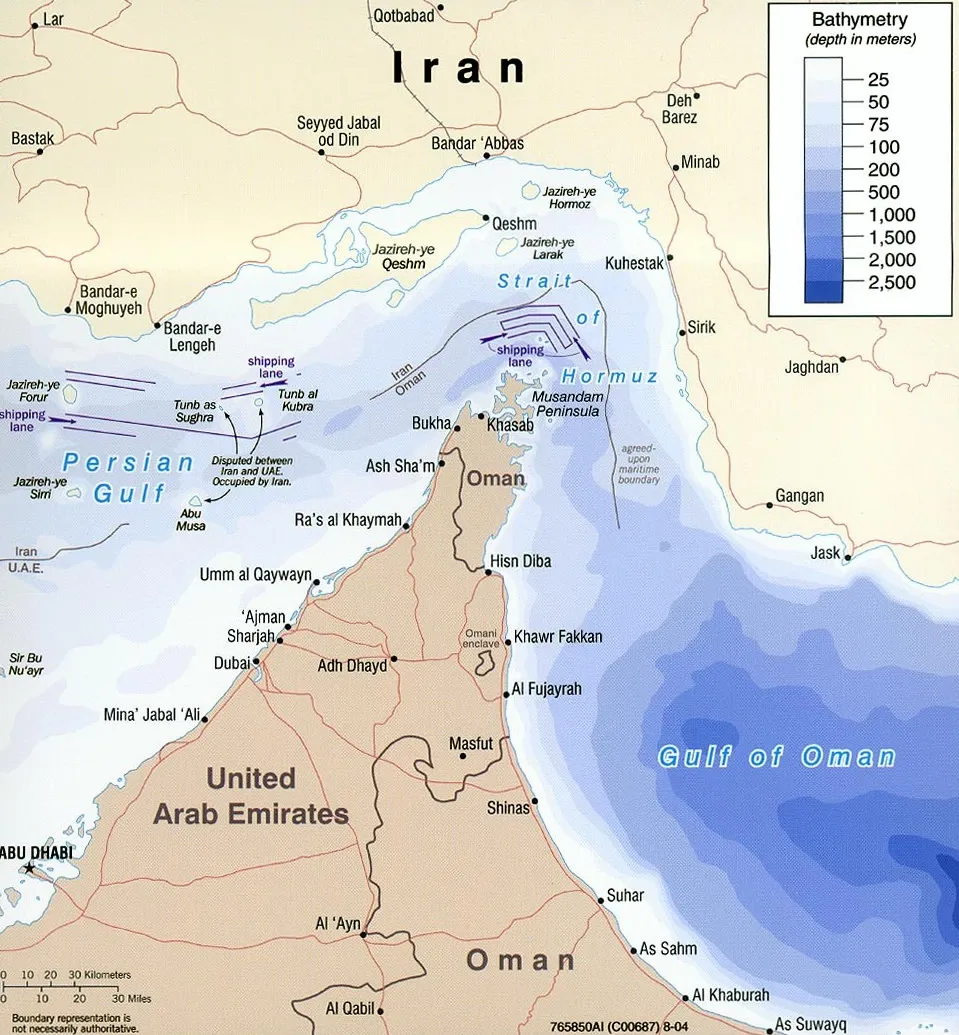
If you are waiting for a container from Shenzhen or Ningbo to reach Jebel Ali, Jeddah or Sohar, the latest maritime-security warning issued on 14 August 2026 should change how you plan your next shipment. The UK Maritime Trade Operations (UKMTO) now reports that many merchant ships are being pushed away from the southern, Omani-coordinated corridor of the Strait of Hormuz and into a northern corridor that is controlled by Tehran. That routing decision is not only a naval risk issue — it directly affects transit times, insurance validity, war-risk premiums and booking strategy for Shipping from China to Saudi Arabia, Shipping from China to UAE and Shipping from China to Oman.
In our earlier Hormuz Strait transit risks guide we explained why the strait is a chokepoint for China–GCC trade. Two weeks later, the situation has shifted again. In this article we look at the new UKMTO data, what the “northern route” really is, and what it means for everyday container cargo from China to the Gulf.
What changed on 14 August? The UKMTO numbers
On 14 August 2026 UKMTO updated its voluntary reporting guidance after a surge of projectile attacks against merchant vessels inside the Strait of Hormuz. The numbers show a clear pattern: Iran and its affiliated forces have concentrated fire on the southern corridor, so ship operators are choosing the northern passage.
| Indicator | Figure | Source / date |
|---|---|---|
| Confirmed projectile incidents since 6 July 2026 | 20 | UKMTO, gCaptain 14 Aug 2026 |
| Incidents in the southern / Omani corridor | 16 | UKMTO 14 Aug 2026 |
| Engine-room hits | 12 | UKMTO 14 Aug 2026 |
| Outbound full Hormuz transits, week ending 14 Aug | 75 vessels | UKMTO / AIS analysis |
| Inbound full Hormuz transits, same week | 76 vessels | UKMTO / AIS analysis |
| AIS-visible transits versus pre-conflict levels | approximately -90% | gCaptain / UKMTO 14 Aug 2026 |
| ADNOC tankers hit during outbound transit, 14 Aug | 2 | WAM / Reuters 15 Aug 2026 |
For context, a normal pre-conflict day would see well over 130 merchant vessels through the strait. A combined total of 151 full transits in a week, split between two narrow corridors, is an extremely thin flow. That is why anyone booking sea freight from China to GCC needs to plan for delays and higher uncertainty, not just headline insurance costs.
What is the Tehran-controlled northern route?
Before the current conflict, most merchant traffic used the Hormuz Traffic Separation Scheme (TSS), a pair of deep-water lanes running roughly through the centre of the strait. When hostilities began, many owners switched to the southern corridor — the part of the strait closest to Oman — because it was supported by the US-led Naval Cooperation and Guidance for Shipping (NCAGS) and was seen as the safer option.
Now Iran has turned that assumption upside down. Of the 20 confirmed strikes since early July, 16 targeted the southern corridor, and 12 hit engine rooms. In response, more ships are moving into the northern corridor, which lies closer to the Iranian coast. That area falls under the operational oversight of the Persian Gulf Strait Authority (PGSA), an entity set up by Iran in the course of the conflict.
The PGSA has demanded a transit “service fee” of 5–7% of cargo value from some vessels, and the Lloyd’s Market Association has warned that paying such a fee may void a ship’s war-risk insurance cover, as we discussed in our Lloyd’s Market Association clause article. Ship operators therefore face a double bind: the southern corridor is under fire, while the northern corridor may invalidate their insurance.
Oil tankers are not container ships: do not trust the headline flow numbers
One common mistake shippers make is to read reports that “Hormuz oil traffic is recovering” and assume that container services are back to normal. The two trades are moving on completely different rules.
According to Bloomberg reporting on 16 August, about 9 million barrels per day crossed Hormuz in the previous seven days through “dark” shuttle transfers and ship-to-ship operations, with roughly 150 vessels waiting off Oman. Those are mostly crude and product tankers, often operating with AIS off, under state-backed programmes, and sometimes carrying out STS transfers outside the strait. They are not general cargo or container ships.
A container liner must keep AIS on, follow fixed schedules, serve multiple GCC ports in sequence, and comply with the war-risk clauses of its flag state and insurers. That is why the weekly container count through Hormuz remains far below pre-conflict levels, even when the oil count looks healthier.
If your cargo is FCL or LCL household goods, electronics, building materials or machinery, the relevant metric is not how much crude crossed the strait last week; it is how many container services can reliably call at Jebel Ali, Jeddah, Dammam, Sohar or Hamad Port on schedule. That number is still constrained.
What this means for your China–GCC cargo by destination
Saudi Arabia (Jeddah, Dammam, King Abdullah Port)
Saudi-bound boxes face the same Hormuz bottleneck as everyone else, plus the added risk at Bab el-Mandeb that we covered in our recent Bab el-Mandeb attack article. If a container service diverts around Africa to avoid both chokepoints, a normal 14–18 day China–Jeddah transit can stretch to 35–45 days. Shippers should consider larger safety stock and earlier bookings for Shipping from China to Saudi Arabia.
UAE (Jebel Ali, Abu Dhabi, Sharjah)
Jebel Ali remains the main transshipment hub for the GCC, but the August attacks on ADNOC tankers show that the UAE corridor is not immune. Two ADNOC vessels were hit during outbound transits on 14 August, and a third attack was reported on 15 August. Many lines are now re-routing via Fujairah Port on the UAE east coast to reduce time inside Hormuz. For time-sensitive goods, the air-freight corridor via Dubai is a useful pressure valve.
Oman (Sohar, Salalah)
Sohar lies just outside Hormuz and is increasingly used as a buffer port: cargo is discharged there and then moved into the UAE or Saudi Arabia by feeder, road or air. The recent oil slicks off Qeshm and Oman underline that the Gulf of Oman is also a contested environment, but for cargo that must avoid Hormuz altogether, Oman is one of the stronger alternatives. Read more in our Container Shipping from China to Oman guide.
Kuwait, Qatar and Bahrain
These markets rely heavily on Jebel Ali transshipment or on direct calls that still pass through the strait. The smaller the market, the fewer direct options, so delays at Jebel Ali quickly ripple through to Kuwait, Doha and Manama. Consolidation and advance booking matter more than ever.
What shippers should do now
- Add buffer stock – If your product has a 14-day sales cycle, do not plan on a 14-day transit. Build in 7–14 extra days for rerouting or port congestion.
- Book earlier than usual – With fewer sailings, space is tightening. Lock in FCL or LCL bookings 3–4 weeks ahead for sea freight to the GCC.
- Confirm insurance cover – Ask your forwarder whether the chosen routing passes through the northern corridor and whether your cargo’s war-risk insurance remains valid. Our Lloyd’s clause article explains the catch-22.
- Split urgent cargo to air – For high-value or time-critical goods, air freight from China to GCC can bypass both Hormuz and Bab el-Mandeb entirely.
- Use Dubai warehousing – Staging inventory in Jebel Ali or Fujairah lets you fulfil Saudi, Oman or Qatar demand without every shipment crossing the strait at the worst moment.
- Check DDP contract terms – Make sure demurrage, detention and force-majeure clauses are clearly assigned. A good DDP forwarder absorbs these risks so you do not have to.
- Monitor UKMTO advisories – The corridor being used today can change within 48 hours. Subscribe to UKMTO or ask your forwarder for daily updates.
How GCC Freight is responding
At GCC Freight we track UKMTO, IMO and flag-state bulletins daily. Our operations team is currently:
- Routing FCL/LCL cargo through the most stable corridor available on each sailing week;
- Offering Dubai and Sohar staging as alternatives when Jebel Ali or Hormuz transit is disrupted;
- Providing sea-air combinations via Oman or the UAE for urgent shipments;
- Confirming war-risk cover and insurance wording before every Hormuz transit;
- Handling customs clearance, SABER and ESMA documentation so that once cargo arrives, it does not sit in port.
If you have containers on the water or are planning a new shipment, the best move is to speak with a forwarder that understands both the Chinese export side and the GCC import side.
Frequently asked questions
Is the northern Hormuz route safe for container ships? It is currently being used because the southern corridor is under heavier attack, but it carries its own risks — including possible interaction with Iranian authorities and insurance-coverage questions. Safety depends on the ship’s flag, insurer and routing approval.
Does the fact that oil is still flowing mean my container will arrive on time? No. Oil tankers and container ships operate under very different rules. The headline flow of crude does not reflect the tight scheduling and insurance restrictions facing liner services.
Will rates for China–GCC shipping rise further? War-risk premiums, bunker surcharges and equipment-imbalance costs are already being passed through. Expect rates to remain elevated while Hormuz remains unstable.
Should I avoid Jebel Ali and use another port? Not necessarily. Jebel Ali is still the largest and best-connected GCC hub. The question is which feeder corridor and staging option gives your cargo the most reliable schedule.
When will Hormuz return to normal? That depends on diplomatic and military developments, not on shipping schedules. Shippers should plan for a prolonged period of disruption rather than wait for a sudden reopening.
Need a reliable China–GCC shipping plan right now?
- WhatsApp: Get a quote now
Hero image: Map of the Strait of Hormuz, public domain, U.S. Federal Government / University of Texas Perry–Castañeda Library Map Collection, via Wikimedia Commons.