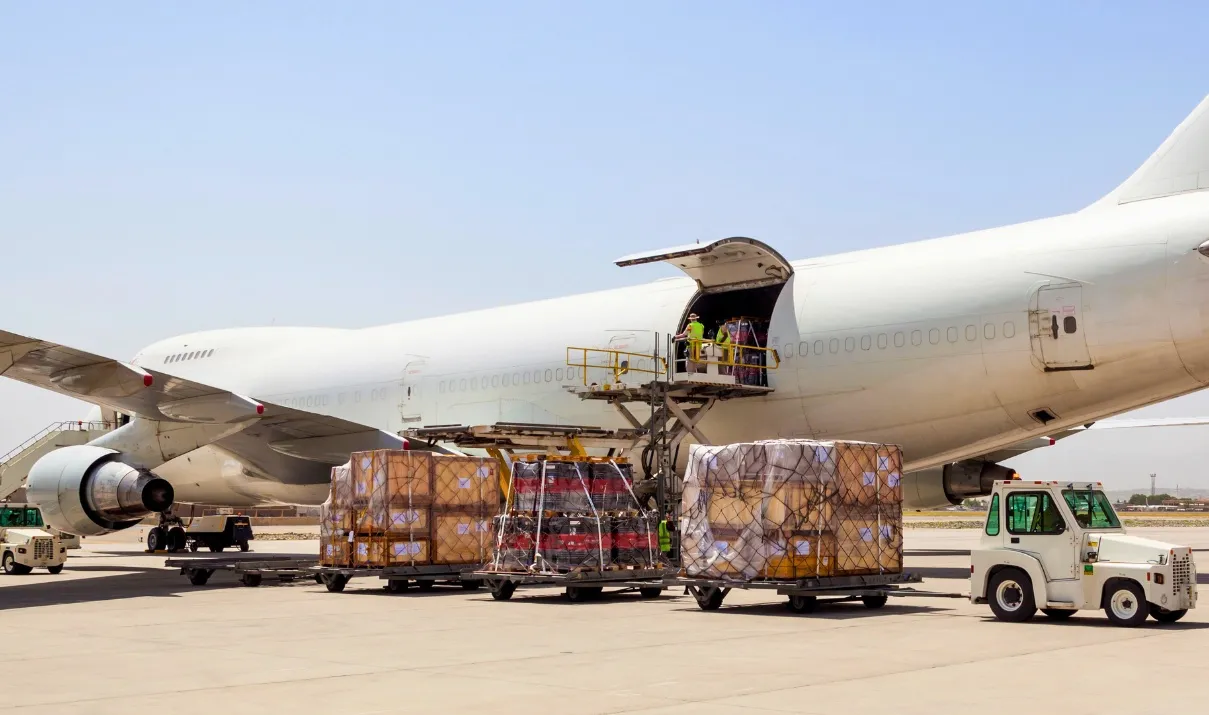
Ask a forwarder what air freight from China to Jordan costs and you will hear something between USD 5.00 and USD 8.00 per kilo, three to seven days, door to door. Both halves of that sentence are usually true and still not enough to plan with, because the per-kilo figure is the one number in the shipment that tells you the least about what you will pay.
In 2026 Jordan became a bigger air freight market than its import volumes alone explain. The Strait of Hormuz has been effectively closed to commercial container traffic since the end of February, sea schedules across the Gulf and the Red Sea have been rewritten twice, and cargo that used to wait for a box has been moving by air. Royal Jordanian says cargo revenue roughly doubled. Queen Alia International Airport (QAIA), the country’s only wide-body gateway, handled 7,594 tonnes in July 2026 and 7,925 tonnes in August, and a new 8,000 square metre cargo terminal built to handle up to 60,000 tonnes a year is now working alongside the older facility.
This guide is about air freight shipping from China to Jordan as it actually runs in November 2026: which routings exist, what each one really costs per chargeable kilo, what the chargeable kilo is, and which costs appear after the plane lands.
Why the market moved
Three separate things changed at once, and it helps to keep them apart.
The first is the sea disruption. With Gulf and Red Sea routings unstable, the usual buffer — send it by sea and accept four weeks — stopped being a reliable plan. Air freight absorbs the urgency that sea freight used to absorb quietly.
The second is capacity. Royal Jordanian took its first Airbus A330 freighter in October, an aircraft with about 65 tonnes of payload, and says it plans to operate three A330Fs and two A321Fs. Those freighters are aimed at lanes between Jordan, the Middle East, Asia and North America, with services to China and the United States still to be launched. Until they are, Chinese-origin cargo reaches Amman almost entirely in the belly of passenger aircraft, through a hub.
The third is the airport itself. The new cargo terminal is operated by Aviation Handling Services Jordan with Menzies Aviation, using an automated storage system for 136 unit load devices. That is a meaningful improvement in how fast a pallet can be broken down, and breakdown speed is where air freight tends to lose its advantage over sea.
Put the three together and you get a market where volumes are up, rates are volatile, and the difference between a good quote and a bad one is no longer the airline’s rate — it is the routing and the paperwork.
There is still no scheduled China–Amman freighter
This is the fact that shapes every China–Jordan air quote, and most rate tables skip it. As of November 2026 there is no scheduled all-cargo service from mainland China to Amman. Every kilo touches at least one hub.
| Routing | Where it connects | Typical transit | What it suits |
|---|---|---|---|
| South China → Dubai → Amman | DXB, belly and freighter feed | 3–5 days | Fastest for Shenzhen and Guangzhou cargo; highest frequency |
| South China → Doha → Amman | DOH, Qatar Airways belly | 3–5 days | Good capacity mid-week; competitive on 100–500 kg |
| East China → Istanbul → Amman | IST, Turkish belly | 5–7 days | Cheapest of the three, slowest, prone to extra handling |
| Hong Kong → Gulf hub → Amman | HKG, mixed | 4–6 days | High-value electronics, when the origin is genuinely Hong Kong |
| Express courier (sample to 100 kg) | DXB or DOH sort | 2–4 days | Documents, samples, replacement parts |
Two consequences follow. First, your transit time is not the flight — it is the connection. A 12-hour flight through a hub is a two-day journey once cut-off times, transfer handling and the second leg are counted. Second, every hub adds a handling event, and every handling event adds a way a pallet can be delayed without anyone on your side being told.
Belly capacity is also the constraint that professional buyers plan around. Passenger aircraft carry freight in the lower deck, sized by the aircraft, not by demand: an A320 or A321 connection offers a fraction of an A330 or 777. When passenger demand rises into October and November, belly freight shrinks, and rates for AMM move before rates for Dubai do.
What the rate actually buys
Air freight rates are quoted per chargeable kilo, and the published ranges for this lane in 2026 look like this:
| Origin | Rate at 100 kg+ (USD/kg) | Typical routing |
|---|---|---|
| Shenzhen (SZX) | 5.20 – 7.80 | Via DXB or DOH |
| Guangzhou (CAN) | 5.00 – 7.50 | Via DXB or AUH |
| Shanghai (PVG) | 5.50 – 8.00 | Via IST or DOH |
| Beijing (PEK) | 5.80 – 8.20 | Via IST or DOH |
| Express courier, under 100 kg | 10.00 – 15.00 | Courier network |
Treat the spread as information rather than noise. Two forwarders can quote USD 3.50 and USD 7.50 for the same carton on the same day and both be telling the truth: one is selling a two-connection routing on a low-cost carrier at the annual low season, the other a prime carrier with a guaranteed booking in a week when belly space is tight. The cheap quote is not a discount. It is a different product with a different number of ways to go wrong.
Three things move the number more than the airline does:
- Weight break. Rates fall at 45, 100, 300, 500 and 1,000 kg. Cargo at 90 kg is often cheaper at the 100 kg rate inclusive of the extra kilos, because the break changes the unit price.
- Chargeable weight. Airlines bill the greater of gross weight and volumetric weight. The volumetric divisor is 6,000 — one cubic metre of carton space is treated as 167 kg whatever it actually weighs.
- Origin charges. Export declaration, terminal handling, screening and a fuel or security surcharge at the Chinese airport are often quoted separately, and on small shipments they can exceed the freight itself.
The 167-kilo trap
Chargeable weight is where most first-time importers lose their margin, and it is arithmetic rather than negotiation.
Volumetric weight in kilograms = length × width × height in centimetres ÷ 6,000.
A pallet of assembled plastic goods, 120 × 100 × 110 cm, occupies 1.32 cubic metres and weighs 95 kg on a scale. Its volumetric weight is 220 kg. You pay for 220 kg, not 95. The freight is 2.3 times what the scale said, and the rate table you negotiated never mentioned it.
The practical rules that follow:
- Ask for the volumetric weight in writing, next to the gross weight, on the same line as the rate.
- Rework packaging before booking, not after. Flattening a carton from 110 cm to 90 cm can remove a third of the chargeable kilos for a rounding error in cardboard cost.
- For low-density cargo — lampshades, packed textiles, foam, hollow plastic — air freight is usually the wrong mode on cost alone, and the volumetric calculation is the reason.
What lands with the pallet at Amman
The freight bill ends at the airport. The import cost does not.
| Cost | Detail |
|---|---|
| Destination handling and airline delivery order | Charged at AMM per shipment and per kilo; small shipments pay disproportionately |
| Customs duty | 0–30% of CIF, by tariff line |
| General sales tax | 16% on the duty-paid value |
| Conformity | JSMO requirements for regulated goods; the standards body published new instructions on product conformity certificates, the Jordanian quality mark and halal certification on 30 July 2026 |
| Brokerage | Optional but usual; a broker holds the file and the release |
Two details cost real money when they are missed. Jordan’s customs value is CIF, so freight and insurance are inside the dutiable base — a cheap freight quote increases the duty you pay. And the de minimis threshold for personal consignments is JOD 200; since 1 February 2026, postal imports at or below that value carry a 16% sales tax with a minimum charge per parcel, so the old assumption that small parcels slide through no longer holds.
The most expensive mistake in this market is not a rate. It is a shipment that arrives before its conformity file does. A pallet held at AMM for a week accrues storage, and the inventory it was flown in to protect is sitting in a warehouse either way.
The Jordanian air market is partly an Iraq market
Jordan has one seaport, Aqaba, and one wide-body airport. In 2026 both got busier for reasons that have little to do with Jordanian consumption: Aqaba Container Terminal set records in three consecutive months, handling 107,803 TEU in September and 109,341 TEU in October, most of the growth in transit cargo.
Air freight follows the same logic, with one honest caveat. For cargo going to Baghdad or Erbil, direct air to Iraq (BGW or EBL) at roughly USD 4.80–8.00 per kilo is usually cheaper than flying to Amman and trucking east, because the truck leg is an extra cost rather than a saving. Amman wins in specific cases:
- the consignee is in Anbar or western Iraq, closer to the Jordanian border than to Baghdad;
- the cargo is consolidating in Amman with other suppliers before crossing;
- Baghdad air capacity is saturated and the shipment cannot wait;
- the goods need to be tendered, inspected or re-labelled in Jordan before the border.
For everything else, the comparison is direct air to Iraq against an Aqaba land bridge that currently runs Aqaba to Baghdad in 10–12 days after the sea leg, and against sea freight to Aqaba at 16–22 days port to port.
When air is the wrong answer
Air freight is a financing decision as much as a transport one. The test is value density: value per kilo, against the cost of the days saved.
A rough threshold that holds in this market: if the goods are worth less than about USD 8–10 per kilo, air freight to Jordan rarely pays on its own, because the freight exceeds a meaningful share of the goods’ value and the cheaper sea option only has to be a few weeks faster than your cash cycle tolerates. Above USD 30 per kilo — electronics, spare parts, medical consumables, cosmetics in small runs, samples for a tender — air usually wins, and the arithmetic is not close.
Seasonality matters too. Capacity tightens from late September through January as consumer electronics peak, again before Chinese New Year when factories push out the last orders, and once more in the weeks before Ramadan when retail restocking compresses into a short window. Book two to three weeks ahead in those periods, and expect the 100 kg break to be the first thing that disappears.
What to put in writing before you book
- Chargeable weight, with dimensions, next to the quoted rate.
- Every leg named, including the hub and whether the second leg is confirmed or space-only.
- The weight break the rate applies to, and the price at the next one up.
- Origin and destination charges itemised separately from the freight.
- Duty and sales tax treatment, and who is the importer of record.
- The conformity position for your product line, confirmed before departure, not on arrival.
- Free time at AMM, and the daily storage rate after it.
None of that is exotic. It is simply the difference between a rate and a landed cost, and in a year when the routing changed twice, the landed cost is the only number worth signing.
If you are shipping to Jordan this quarter, send us the carton dimensions, the origin city and the consignee governorate. We will return the chargeable weight, the routing with the hub named, and the duty and sales tax as separate lines — so the quote you approve is the invoice you receive.
- WhatsApp: Get a quote now